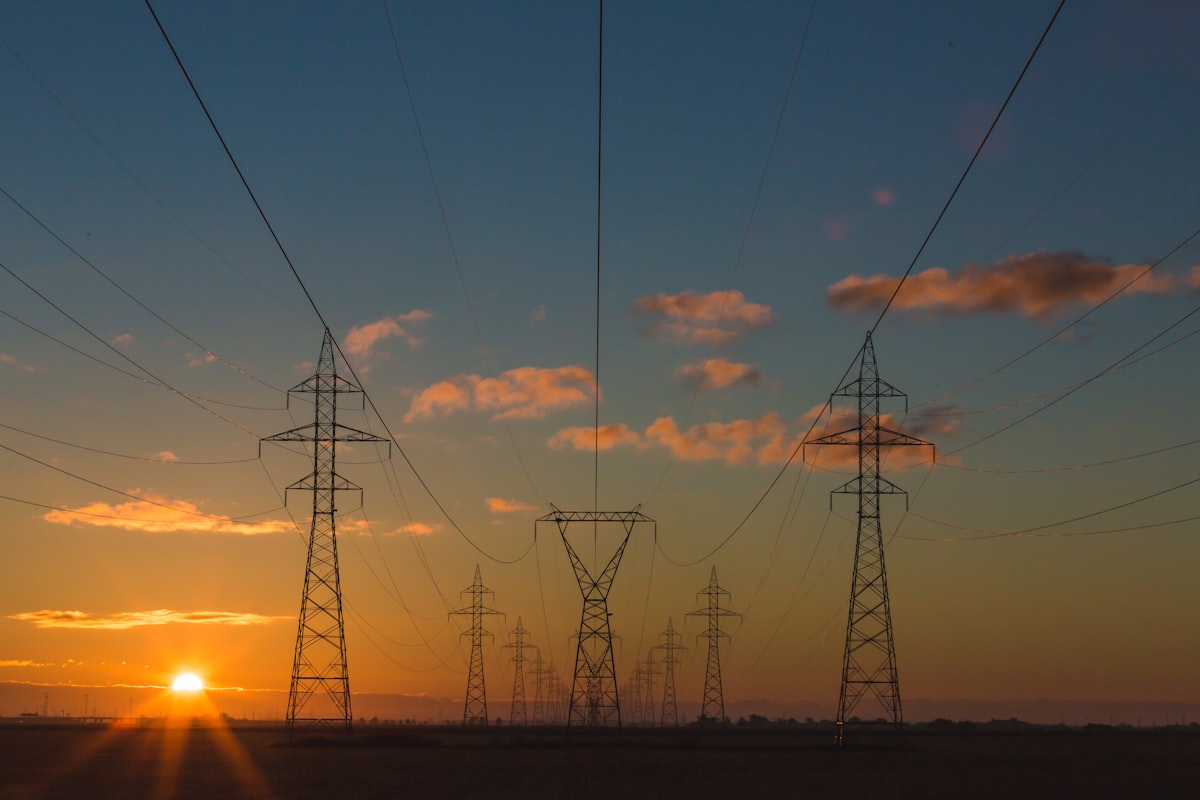
A rural Georgia family agreed to sell the home Brown’s mother had lived in for years because, in her daughter’s words, fighting Georgia Power in court was not a fight they could win. Ansley Brown told CBS News (Skyler Henry and Shannon Luibrand, July 13, 2026) that the utility made clear it could take the property by eminent domain if it had to. “To us it’s theft,” Brown said. “It’s literally a billion dollar company stealing land from smaller people, people who can’t fight back. We don’t have the money to fight Georgia Power.” The reason the line is being built, per Georgia Power’s own estimate, is that 70-80% of its capacity will serve AI data centers.
The single-parcel story is a window onto a much larger plan. Behind Brown’s home sits a 35-mile easement expansion tied to Plant Wansley that, on Georgia Power’s own count, runs through more than 300 parcels. Behind that sits a 1,000-mile, ten-year buildout of new transmission lines across the state. And behind that sits the question every Georgia household will be asked to answer over the next decade: who actually pays for the AI power surge, and in what form.
What Georgia Power Says It Is Building
The numbers come from the utility and from GPB News reporting on June 23, 2026 (Grant Blankenship). A separate Associated Press report published by CBS Atlanta on December 5, 2025 documents the system-level case Georgia Power put before the Georgia Public Service Commission. The picture the three sources draw together is consistent.
Georgia Power told regulators it needs a 50% increase in generating capacity over six years, or roughly 10,000 megawatts of new supply, at a construction cost of more than $15 billion. The AP report, citing the company’s own filing, says 80% of that new capacity is meant to serve data centers. The 1,065 miles of new transmission lines the utility has disclosed is a separate line item on top of the generation build, and the GPB News story confirms that “80% of the growth that we are seeing in the state of Georgia is data centers” in the words of Georgia Power spokesperson Meredith Stone.
For the line that runs by Brown’s property, CBS News reports the allocation is 70-80% data center, 20-30% residential and commercial. The 35-mile, 300-parcel scope is Georgia Power’s own estimate of the land it has to acquire for the Plant Wansley expansion. Brown said the utility told her family it would seek eminent domain if it could not reach a deal. Holly Lovett, a Georgia Power spokesperson, told CBS that eminent domain “is always … a last resort for us and it’s something we never want to do.”
The Pushback, and What It Costs the Holdouts
Not every landowner on the Plant Wansley route took the first offer. GPB News identified Coweta County resident Cynthia Van Epps, who refused to sell and now expects a 500-kilovolt line “about 12 feet from her bedroom window.” Her reaction to Georgia Power’s opening offer of 125% of fair market value: “This house wasn’t for sale.” Van Epps called the offer a “lowball.”
Georgia Power’s defense to the PSC, per the AP report on CBS Atlanta, is that data-center customers “pay upfront the full costs of serving them, commit to long-term contracts, and provide financial guarantees.” In other words, the utility is asking the commission to approve the build on the theory that the hyperscaler tenants are the ones funding it, not residential ratepayers.
Consumer and environmental groups who appeared before the commission said the math is not that clean. Brionte McCorkle of Georgia Conservation Voters, quoted in the AP report, told the commission: “What we don’t want is a form of corporate welfare, where individual citizens are paying for the benefit of big mega corporations like Meta and Amazon.” Charles Hua of Powerlines told the AP that “you’re seeing electricity demand grow at the fastest rate in decades, and you’re seeing electricity prices rise at the fastest rate in decades.” Georgia Power pushed back on the claim that the rate impact would be roughly $20 a month per residential customer, calling that figure “flatly incorrect,” but the underlying premise that residential bills will move at all is not in dispute.
What This Means
The Georgia case is what the AI buildout looks like when it lands on one specific parcel of land. A line that crosses 35 miles of rural Georgia, takes 300 properties, and runs 70-80% for compute farms in Atlanta, Douglas County, and beyond, is the same trade that 30+ other states are now negotiating. The political pressure is no longer abstract: data centers are already a midterm issue in Pennsylvania, Missouri, and Virginia, and we have covered that ground in detail.
What is new in the Georgia story is the combination. It is not just a rate-hike fight, and it is not just a noise-or-water fight, and it is not just a job-versus-environment fight. It is a property-rights fight in which the line is being routed through homes, and the people on the receiving end of a “last resort” letter from a state-regulated monopoly are being told to take the check. McCorkle’s “corporate welfare” framing, the 125%-of-fair-market-value “lowball,” and Brown’s “we don’t have the money to fight Georgia Power” are three different angles on the same structural issue. If the AI buildout is going to be financed the way Georgia Power is proposing, the people sitting on the path of the line need to be part of the conversation, not just the route.
For readers outside Georgia, the question to ask of any local utility in the next 18 months is direct: what percentage of your new transmission-line capacity is contracted to data centers, how many residential parcels does it cross, and what is the per-parcel compensation offer relative to a true arms-length sale. The pattern will repeat.
The Bottom Line
A rural Georgia family lost a home to a 35-mile line that is being built, on the utility’s own numbers, mostly to move power to AI data centers. The story is the cleanest read yet on what “AI infrastructure” looks like when it arrives on a single piece of land, and it is the version the industry will need to answer before the next route is drawn.
For more on the AI-infrastructure beat, see our other data center analysis.